Download
1 / 6
70 likes | 192 Views
This guide explains the properties of parabolas, including the definition, vertex, focus, and directrix. A parabola consists of all points equidistant from a fixed line (directrix) and a point (focus). The standard equation for vertical and horizontal parabolas is provided, along with examples illustrating how to find the vertex, focus, and directrix from given equations. It also includes guidance on completing the square to convert general parabolic equations into standard form. Perfect for students learning about conic sections!

E N D
10.2 Parabolas
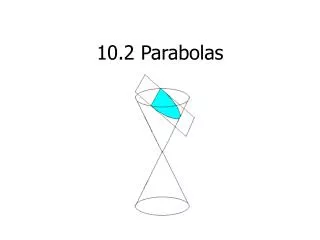
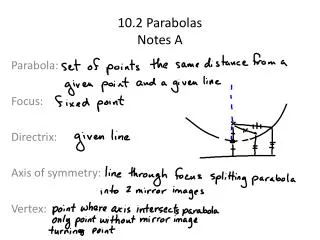
10.2 Parabolas A parabola is the set of all points (x,y) that are equidistant from a fixed line (directrix) and a fixed point (focus) not on the line. Focus (h, k + p) Vertex (h,k) Directrix y = k - p
Standard Equation of a Parabola (x - h)2 = 4p(y - k) Vertical axis Opens up (p is +) or down (p is -) (y - k)2 = 4p(x - h) Horizontal axis Opens right (p is +) or left (p is -)
Ex. Find the vertex, focus, and directrix of the parabola and sketch its graph. y2 + 4y + 8x - 12 = 0 Now complete the square. y2 + 4y = -8x + 12 y2 + 4y + 4 = -8x + 12 + 4 (y + 2)2 = -8x + 16 Write down the vertex and plot it. Then find p. (y + 2)2 = -8(x - 2) 4p = -8 p = -2 What does the negative p mean? left
Directrix x = 4 V(2,-2) F(0,-2) Homework: 5 - 29 odd
Ex. Find the standard form of the equation of the parabola with vertex (2,1) and focus (2,4). First, plot the two points. Which equation will we be using? Vert. or Horz. axis Right, since the axis is vertical, we will be using (x - h)2 = 4p(y - k) What is p? p = 3 Now write down the equation. (x - 2)2 = 12(y - 1)