Unveiling Minerals: Formation, Composition, & Crystal Shapes
200 likes | 365 Views
Explore the fascinating world of minerals, their formation, structure, and importance. Learn about crystal shapes, mineral composition, and the processes involved in mineral formation. Discover how minerals shape the Earth's surface.


Unveiling Minerals: Formation, Composition, & Crystal Shapes
E N D
Presentation Transcript
Chapter 3Minerals Lesson 1 What is a mineral? Pages 76-84
Chapter Introduction What are minerals and why are they useful? http://www.redorbit.com/news/video/education_1/1112810933/what-is-a-mineral/
Chapter Introduction SS#1 Sept. 24, 2013
What is a mineral? crystalsolid chemical substance with a regular, repeating arrangement of its atoms crystallizationwhen particles dissolved in a liquid solidify to form crystals lava molten rock that erupts onto Earth’s surface magmamolten rock material under Earth’s surface Silicate a mineral group that has silicon and oxygen in its crystal structure
What is a mineral? • I can explain: • What is a mineral? (5 characteristics) • What the 6 crystal shapes are? • How minerals form? (3 ways plus an example) • What the common rock-forming minerals are? (2 groups plus an example)
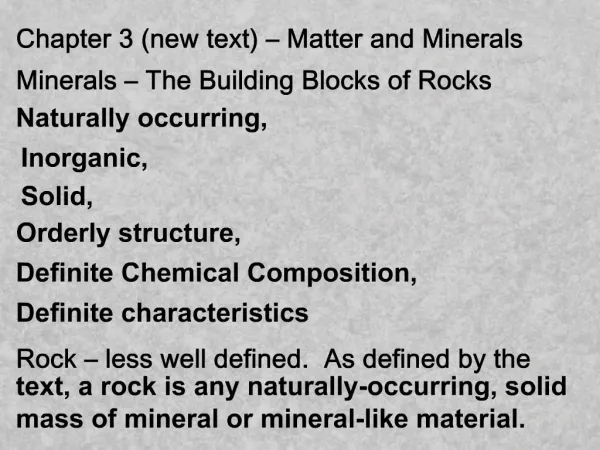
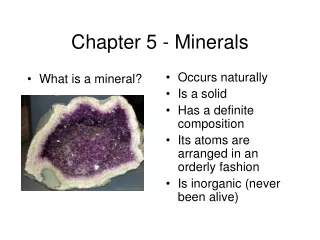
Lesson 1 Notes – What is a mineral? • Minerals arenaturally occurring, inorganic(non-living) solidsthat have adefinite chemical compositionand join together in an orderly crystal structure. Minerals naturally occurring inorganic orderly crystal structure solids definite chemical composition
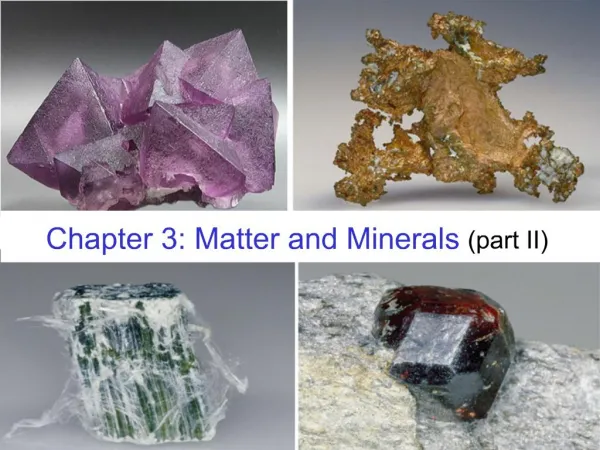
The Structure of Minerals • Minerals occur in many different shapes. • When a crystal forms under the right conditions and has time to grow, it will develop a characteristic crystal shape. • Most of the time, minerals grow in tiny clusters.
Crystal Shapes – Hexagonal Four axes, three are equal in length and lie at an angle of 120° from each other. • Triclinic • 3 axis, all unequal and none at 90° angles. • Orthorhombic • All axis unequal in length, and 90° degrees from each other.
Crystal Forms – • Monoclinic • All axis unequal in length. Two of them are at right angles to each other, while the third is lies at an angle other than 90°. • Tetragonal • Three axes, two are equal in length, one is unequal.) • Isometric/Cubic • All three axes are equal in length and at 90° degrees from each other.
How do minerals form? • Minerals can crystallize from either hot or cool solutions. • As water evaporates from a cool solution in a dry environment, solids crystallize out of the water and form minerals. Example – halite
How do minerals form?(cont.) • Hot solutions are made when water flows through cracks in the earth’s crust into deep and hot environments. • Sometimes hot solutions carry large concentrations of dissolved solids that eventually become valuable mineral deposits. Example - gold
How do minerals form?(cont.) • Minerals can also form from magma. Magmais molten material stored beneath Earth’s surface. • When magma erupts on or near Earth’s surface, it is called lava or ash.
How do minerals form?(cont.) • As lava above ground coolssmall crystals form quickly on or near Earth’s surface. • Also asmagma cools and crystallizes slowly below Earth’s surface, atoms and ions arrange themselves and form large mineral crystals. Example – Quartz
The Structure of Minerals • The common rock-forming minerals are composed of combinations of elements that are abundant in Earth’s crust. • Oxygen and silicon are the two most abundant elements in the crust.
The Structure of Minerals(cont.) The two main families of rock-forming minerals are the silicates and the nonsilicates. • A silicate is a member of the mineral group that has silicon and oxygen in its crystal structure. Example:Quartz, Feldspar, Olivine and Mica • Nonsilicate minerals do not contain silicon. Example: Calcite and Halite
A mineral is a naturally occurring, inorganic solid with a definite chemical composition and crystalline form. • Crystal shape reflects the internal arrangement of atoms or ions. • The most common rock-forming minerals are silicates.
Lesson 1 – LR1 What type of chemical composition do minerals have? A. definite B. indefinite C. unstable D. stable
Lesson 1 – LR2 The common rock-forming minerals are composed of combinations of elements found in which part of the Earth? A. mantle B. core C. crust D. oceans
Which process occurs when particles dissolved in a liquid or gas solidify and form crystals? A. evaporation B. disintegration C. crystal growth D. crystallization
1. A mineral is anything solid on Earth. 2. Some minerals form when water evaporates from Earth’s surface. Do you agree or disagree?