Download
1 / 16
160 likes | 285 Views
This historical overview examines the evolution of disaster relief in the United States, tracing the transition from the ad hoc approaches before World War II to organized preparedness and mitigation efforts post-war. Key developments include the establishment of civil defense councils, legislative milestones like the Disaster Relief Act of 1950, and the creation of FEMA in 1979, underlining the shift to a coordinated, all-hazards approach. Highlighting major events and policies, this overview provides insights into how federal, state, and local roles have evolved in response to disasters, and the increasing focus on community resilience.

E N D
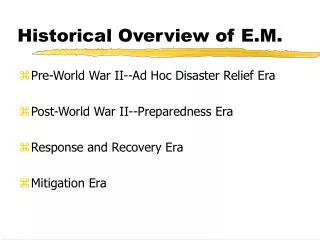
Historical Overview of E.M. • Pre-World War II--Ad Hoc Disaster Relief Era • Post-World War II--Preparedness Era • Response and Recovery Era • Mitigation Era
Pre-World War II Era • No continuous Federal Government Role • Congressional Disaster Relief Bills: ~100 • Civil Defense Councils created in WW I • 1928 Lower MISS. Flood Control Act • 1933 Earthquake Measure • 1934 Highway Damage Repair • 1936 National Flood Control Act
World War II Civil Defense • In Department of War--Focused on: • Air raid watch, warning, alert systems • Rescue units • Shelter management • Public Information • Volunteer Training
Early Post World War II • Refusal to implement Federal program • International Atmosphere Sours • Federal Civil Defense Administration, 1950
Disaster Relief Act of 1950 • Permanent Disaster Relief Program • Philosophy--Supplement S&L Efforts • Funding for State/Local Govt only • Cost-Sharing Introduced • Authority to Declare -- The President
Civil Defense Policy Changes • Blast Shelter Program Proposals • Evacuation Program Proposals • Evacuation Policy Questioned • Joint Federal-State/local Responsibility • 50/50 Matching P&A Program • Fallout Shelter Program
President Kennedy and CD • CD as Insurance Policy-Deterrence Failure • Identify Existing Fallout Shelter Space • License, Mark and Stock Shelters • Upgrade Sub-Standard Shelter Spaces • Construct Shelters in Deficit Areas • Home Shelter Construction Information
1960s and 1970s • Dual-Use • Hurricane Camille • Crisis Relocation Planning • Tropical Storm Agnes • National Earthquake Hazards Reduction Act • National Governor’s Association Report on E.P. • Three Mile Island
Governor’s Association Rpt • Consolidate Disperse Federal Programs • Greater State/Local Fund Discretion • Adopt Comprehensive Emergency Mgmt. • Mitigation & Recovery--Greater Attention
1979: FEMA Created • Consolidating Myriad Federal Programs • Prime Role in Federal Disaster Policy • Coordinator of Federal Disaster Response • All-Hazards Approach comes to the fore
1980: Superfund LawLocate, Investigate, Clean-Up Worst Sites • Established prohibitions/requirements for closed/ abandoned hazardous waste sites. • Provided for liability of those responsible for releases of hazardous waste sites. • Established clean-up trust fund where no responsible party found.
1986: CERCLA SARA Title III • Look for permanent/innovative solutions. • Consider other Environmental laws. • New Enforcement authorities. • More State involvement. • More focus on human health problems. • Increased size of trust fund to $8.5 billion. • Greater citizen participation--LEPC’s
CD: Going, Going -- Gone • 1980: Title V, Civil Defense Act of 1950 • 1982: President Reagan $4.2B NSDD • 1983: IEMS • 1987: Presidential Policy Guidance-Surge • 1993: Civil Defense Act Abolished
Disaster Response Era • 1988 Robert T. Stafford Disaster Relief Act • 1989: Hurricane Hugo Criticism • 1990: Federal Response Plan Draft • 1992: Hurricane Andrew Criticism
James Lee Witt Era • Mitigation to the Forefront • Reforms Disaster Relief Apparatus • Customer Service Becomes FEMA Priority • Project Impact--Disaster Resistant Comn.