Download
1 / 31
310 likes | 436 Views
This unit covers the critical importance of vehicle inspections in the fire service. It emphasizes the need for operators to identify vehicle issues that can be repaired and those that require professional service. The unit also explains the significance of documenting vehicle inspections, repairs, and maintenance to ensure accountability and enhance vehicle safety. Operators will learn to conduct thorough vehicle checks and understand readiness for field operations. Additionally, it highlights tasks that can be performed by the operator and those that are beyond their capabilities.

E N D
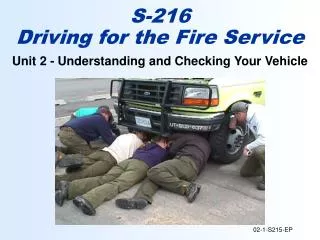
Unit 2 - Understanding and Checking Your Vehicle S-216Driving for the Fire Service
Unit 2 - Understanding and Checking Your Vehicle 1. Explain why it is important to perform a vehicle inspection. 2. Differentiate between vehicle problems that are operator repairable and those that are not.
Unit 2 - Understanding and Checking Your Vehicle 3. Explain why it is important to document any actions taken concerning the vehicle such as inspections, use, repairs, maintenance, accidents, etc. 4. Perform a vehicle inspection. Determine your vehicle's readiness for daily operations in the field.
I. Reasons for Performing a Vehicle Inspection A. Vehicle/equipment readiness B. Accident prevention C. Preventive maintenance is less expensive than repairs. 02-4-S216-EP
II. Vehicle Repairs and Maintenance Tasks an operator can perform: 1. Change flat tire 2. Replace missing lug nuts 3. Fluid levels 4. Replace fuses 5. Replace light bulbs 6. Replace lenses 02-5-S216-EP
II. Vehicle Repairs and Maintenance Tasks an operator can perform: 7. Replace/tighten mirrors 8. Tighten any loose nuts, bolts fasteners etc. 9. Battery service 10. Replace air filters 11. Replace missing safety items 02-6-S216-EP
II. Vehicle Repairs and Maintenance Problems that are not operator repairable: 1. Wiring/electrical problems 2. Major fluid leaks/changing fluids 3. Major tire/wheel problems 4. Broken glass 02-7-S216-EP
II. Vehicle Repairs and Maintenance Problems that are not operator repairable: 5. Mechanical problems a. Engine b. Transmission/transfer case/ driveline/differential c. Brakes d. Steering components/ Constant Velocity joints 02-8-S216-EP
II. Vehicle Repairs and Maintenance Problems that are not operator repairable: 6. Exhaust system 7. Belts/hoses 8. Repair safety items 02-9-S216-EP
III. Documentation A. Cost accountability. Refer to agency- specific financial requirements. B. Organizational/Agency liability or personal liability. C. To discover mechanical trends with that vehicle that can help with the maintenance of similar vehicles. 02-10-S216-EP
III. Documentation D. As a reminder when certain mechanical service was performed or when problems arose. E. Helps in the development of new and safer equipment. F. Documentation for warranty issues that may arise. G. Document job performance and compliance with organization policies and procedures.
Unit 2 - Understanding and Checking Your Vehicle 1. Explain why it is important to perform a vehicle inspection. 2. Differentiate between vehicle problems that are operator repairable and those that are not.
Unit 2 - Understanding and Checking Your Vehicle 3. Explain why it is important to document any actions taken concerning the vehicle such as inspections, use, repairs, maintenance, accidents, etc. 4. Perform a vehicle inspection. Determine your vehicle's readiness for daily operations in the field.