Understanding Inseparable Prepositions: Usage and Examples in Hebrew
20 likes | 124 Views
This guide explores inseparable prepositions in Hebrew that are directly attached to nouns. It outlines the meanings and uses of prepositions like בְּ (in, with, at), לְ (to, for), and כְּ (like, as). Examples illustrate how לְ can indicate becoming or possession, while כְּ conveys similarity. The text provides an extensive look at these prepositions' functions within sentences, ensuring learners grasp their nuanced meanings and applications. Ideal for students of Hebrew language and grammar.


Understanding Inseparable Prepositions: Usage and Examples in Hebrew
E N D
Presentation Transcript
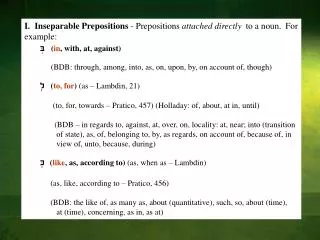
I. Inseparable Prepositions - Prepositions attached directly to a noun. For example: בְּ(in, with, at, against)(BDB: through, among, into, as, on, upon, by, on account of, though)לְ(to, for) (as – Lambdin, 21)(to, for, towards – Pratico, 457) (Holladay: of, about, at in, until) (BDB – in regards to, against, at, over, on, locality: at, near; into (transition of state), as, of, belonging to, by, as regards, on account of, because of, in view of, unto, because, during) כְּ(like, as, according to) (as, when as – Lambdin) (as, like, according to – Pratico, 456) (BDB: the like of, as many as, about (quantitative), such, so, about (time), at (time), concerning, as in, as at)
Withהָיָה – • לְtakes on the meaning of “becoming” For example: משֶׁה לְנָבִיא צַדִּיקהָיָהLiteral: Was Moses to prophet righteous. Idiomatic: Moses became a righteous prophet. • לְtakes on the meaning of past tense possession: For example:שִׁפְחָה לַאִשָּׁההָיָהLiteral:There was maidservant to the woman. Idiomatic: The woman possessed (or had) a maidservant. • כְtakes on the meaning of “like” or “acting like”For example: הַנַּעַר לַאִישׁ כְּבֵּןהָיָהLiteral: Was the boy to the man like son. Idiomatic: The boy was like a son to the man.