Emulation Facility for Research: Cluster and Network Innovations
270 likes | 381 Views
The research paper discusses a configurable Internet cluster designed for experimental computer science research. Featuring 230 nodes and 1000 links, this facility allows researchers to emulate various network configurations and test distributed systems, active networks, web caching, and more. The system is user-friendly and significantly scales from basic setups to complex experimental conditions. It addresses challenges in resource control and offers insights into the behavior of distributed systems and network performance. The facility is openly available for remote experimentation and collaboration among researchers.


Emulation Facility for Research: Cluster and Network Innovations
E N D
Presentation Transcript
Cluster or Network?An Emulation Facility for Research Jay Lepreau Chris AlfeldDavid Andersen (MIT) Mac NewboldRob Place Kristin Wright Dept. of Computer ScienceUniversity of Utah http://www.cs.utah.edu/flux/testbed/ February 3, 2000
Research We Do • Operating systems, local and distributed • Distributed systems • Web caching schemes, distributed objects, ... • Active Networks • code in every packet: route me! • Configurable router • Router operating systems
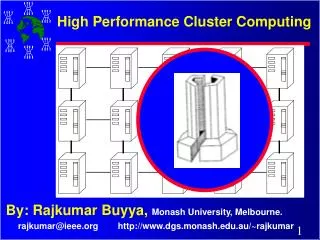
What? • A configurable Internet (cluster) in a room • 230 nodes, 1000 links, BFS (switch) • virtualizable topology, links, software • An instrument for experimental CS research • Universally available to any remote experimenter • Simple to use!
Why? • “We evaluated our system on five nodes.” -job talk from university with 300-node cluster • “We evaluated our Web proxy design with 10 clients on 100Mbit ethernet.” • “Simulation results indicate ...” • “Memory and CPU demands on the individual nodes were not measured, but we believe will be modest.” • “The authors ignore interrupt handling overhead in their evaluation, which likely dominates all other costs.” • “Resource control remains an open problem.”
Why 2 • “You have to know the right people to get access to the cluster.” • “The cluster is hard to use.” • “<Experimental network X> runs FreeBSD 2.2.x.” • “October’s schedule for <experimental network Y> is…” • “<Experimental network Z> is tunneled through the Internet”
Complementary to Other Experimental Environments • Simulation • Small static testbeds • Live networks • Maybe someday, a large scale set of distributed small testbeds (“Access”)
Some Unique Characteristics • Significant scale: initially 225 nodes, degree four 100Mb links between 42 core routers. • User-configurable control of “physical” characteristics: shaping of link latency/bandwidth/drops/errors(via invisibly interposed “shaping nodes”),router processing power, buffer space, … • Node breakdown: 42 core, 160 edge, 26 shaping, 2 management
More Unique Characteristics • Capture of low-level node behavior such as interrupt load and memory bandwidth • User-replaceable node OS software • User-configurable physical link topology(VLAN via BFS; “P-LAN” via BFPP) • Completely configurable and usable by external researchers, including node power cycling
Feature:Automatic mapping of desired topologies and characteristics to physical resources • Algorithm goals: • minimize likelihood of experimental artifacts (bottlenecks) • “optimal” packing of multiple simultaneous experiments • Complete in finite time! • Constraint-based heuristic algorithm (version 2!) • Feature: accepts ns-compatible specification
Current Algorithm • Simulated annealing • Make random change (move node from one switch to another), compute score, accept/reject based on current temp. • Heuristic algorithm • ~ 4 seconds for 30 nodes; polynomial • Improve: • Hardwired node connections will slow it down x100 • Edge nodes • Speed - incremental score recomputation
Research Applications • Simulation validation • Active networks • Resource demands of services inside routers • Denial-of-service resistance • Interaction of adaptive applications and protocols • All sorts of distributed system experiments • ...
Research Applications (continued) • Detailed performance monitoring and analysis • Relationships between {node, link, topology} characteristics and • Application performance • Task scheduling and assignment • Communication software • Application algorihms • ….
Study: Interconnection Techniques • Point-to-point vs.always through a switch • Salmon et al (Caltech) • Cost vs. performance • Of most interest on large clusters • Locality of communication patterns • Interference with local processing • Ad hoc mobile networking
Research Issues and Other Challenges • Calibration, validation, and scaling: how to emulate different speed networks? Scaling behavior of emulating faster links by slowing nodes? • Can we sufficiently capture real router internal behavior in a PC? • Assuring validity: detecting switch bottlenecks, measuring and controlling physical characteristics without introducing artifacts. • Algorithms and software to map requirements to resources while minimizing artifacts. • Integrate with ns? • Providing a reasonable user interface to all this.
Final Remarks • Should be limping next month • Looking for feedback on your potential use • Looking for early users • Collaborators/clients: UU Physics, CMU CS, MIT CS, Georgia Tech, IBM research • Sponsors: University of Utah, Novell, DARPA, Compaq, Nortel, <your_name_here>